

Paid Leads vs Organic Enquiries: What’s the Real Cost Per Conversion?
Every real estate business eventually asks the same question: should we pay for leads, or invest in generating enquiries organically? It sounds like a budgeting decision, but it is really a maths decision — and the number that settles it is not what a lead costs to acquire, but what a closed deal costs to acquire.
That figure is your true cost per conversion, and paid and organic channels look very different the moment you measure it properly. Here is how to compare them honestly, with a worked example, and why the smartest real estate businesses refuse to choose just one.
Cost per lead is a vanity metric
A ₹200 lead is not cheap if none of those leads ever buy. A ₹2,000 lead is not expensive if one in ten closes. Cost per lead flatters channels that produce cheap, low-intent enquiries and punishes channels that produce fewer, better ones — which is exactly backwards from how you should be thinking.
Cost per conversion fixes that. It folds in lead quality, follow-up effort and close rate — the things that actually decide whether your marketing made money. The calculation is deliberately simple; it is the discipline of measuring it honestly that most teams skip.
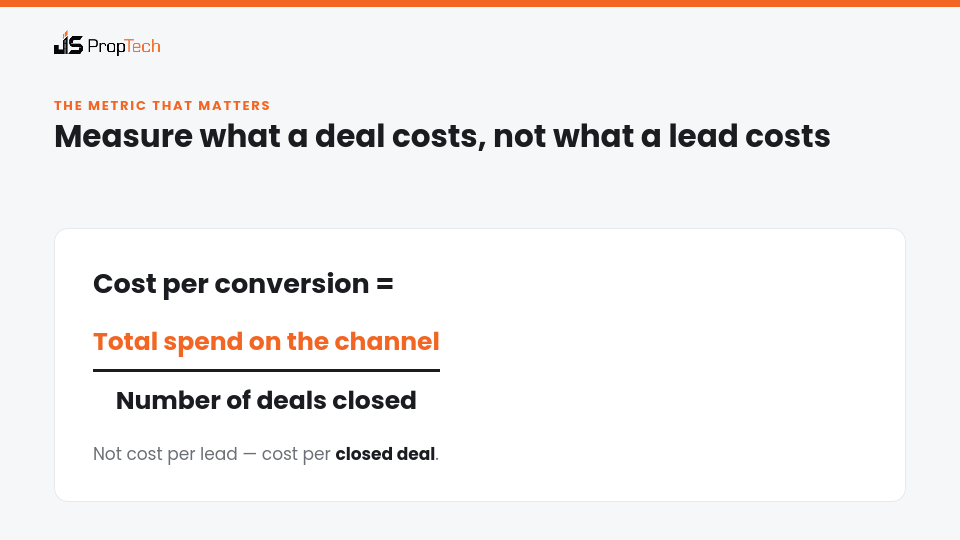
The trap is the phrase total spend. It is not just your ad budget or agency retainer. It includes the hours your team spends chasing enquiries, the tools and CRM you pay for, and the deals you quietly lose by following up late. Leave those out, and every comparison you make will be wrong before you start.
Paid leads: fast, predictable, and front-loaded
Paid channels — Google Ads, Meta Ads and portal listings — buy attention immediately. Switch them on and enquiries arrive the same week. For a launch, or a quarter where you need volume now, nothing else matches that speed, and you can scale a winning campaign the moment you find one.
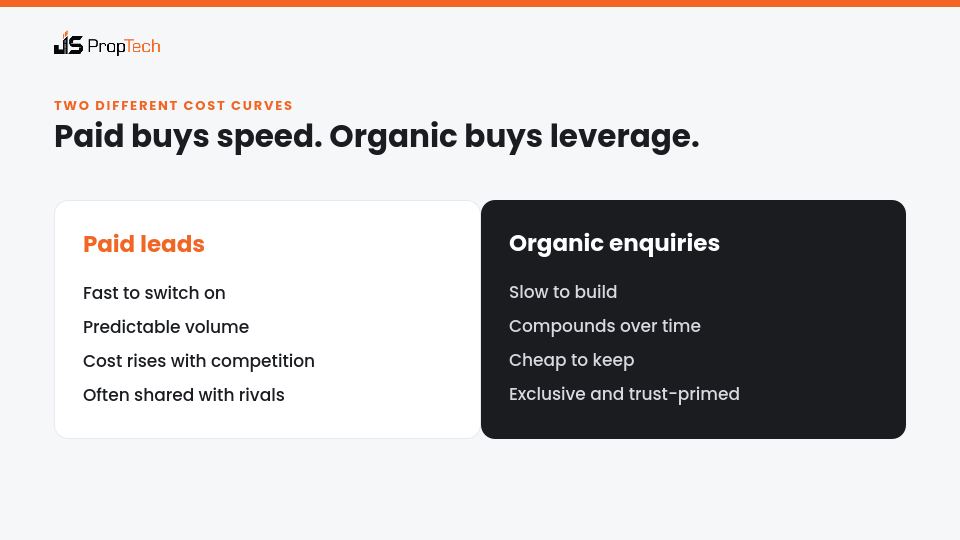
The trade-offs are just as real. Paid leads stop the moment you stop paying, costs climb as more advertisers compete for the same pin codes, and portal leads are often shared with three or four other brokers — which quietly drags your close rate, and your true cost per conversion, in the wrong direction. Paid is rented attention: powerful while the meter runs, gone the instant it stops.
Organic enquiries: slower to build, cheaper to keep
Organic enquiries come from search rankings, your Google Business Profile, social content, referrals and your own website. They take months of consistent effort before they produce real volume, and the early cost per lead can look terrible — because you are paying to build an asset that has not started paying you back yet.
Then the curve flips. Once a page ranks or your Business Profile starts pulling local searches, each extra enquiry costs almost nothing. Organic leads are usually exclusive to you and arrive already trust-primed, so they close at a higher rate. Better still, organic is owned rather than rented — it builds brand equity a competitor cannot switch off by outbidding you. Over a long enough window, it is almost always the lower cost per conversion; it just asks for patience that paid does not.
The hidden costs both sides ignore
Two invisible costs distort nearly every comparison brokers make, and both hit paid leads hardest because you paid cash up front for every one you waste. The first is speed. A brilliant lead left unanswered for two hours is often worth less than an average lead answered in two minutes — enquiry intent decays fast, and the buyer who filled in your form is, in that same moment, filling in three others. The first broker to respond frames the conversation and usually keeps it.
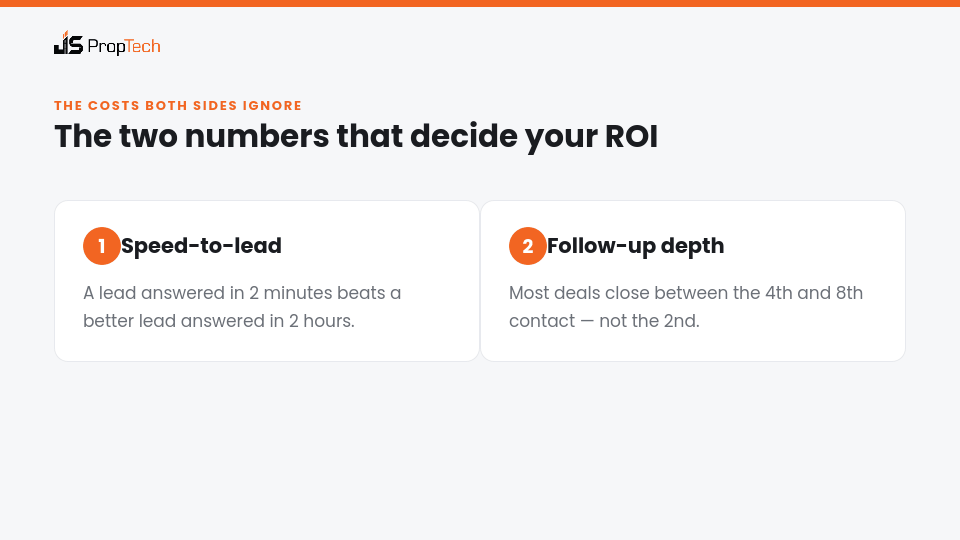
The second is follow-up depth. Most property deals close between the fourth and eighth contact, yet many teams give up after the second. If your follow-up stops early, you are discarding leads you already paid for — which inflates the cost per conversion of every channel at once. Both of these are process problems, not budget problems, which makes them the cheapest ROI you will ever buy: no extra ad spend required, just a faster, longer follow-up.
A worked example
Say a paid campaign spends ₹40,000 in a month and brings 200 enquiries, of which four become deals. That is a ₹200 cost per lead — and a ₹10,000 cost per conversion. Now say organic costs you ₹30,000 that quarter in content, tools and time, and brings 60 enquiries and three deals. On cost per lead, organic looks far more expensive (₹500 versus ₹200) and you might be tempted to cut it.
But measured properly, organic already matches paid at ₹10,000 per conversion — and here is the part cost per lead hides completely: next quarter that same content keeps ranking and brings another 60 enquiries at almost no additional cost, halving its cost per conversion, while the paid campaign needs the full ₹40,000 again just to stand still. The exact numbers will differ for your business. The lesson will not: cost per lead told you to cut the wrong channel, and cost per conversion told you the truth.
To run this for yourself, take one quarter and tag every enquiry by source, then track four numbers per channel: total spend including team time, enquiries received, deals closed, and average commission earned. Calculate cost per conversion and return per conversion for each, and the right budget split usually becomes obvious.
What we recommend
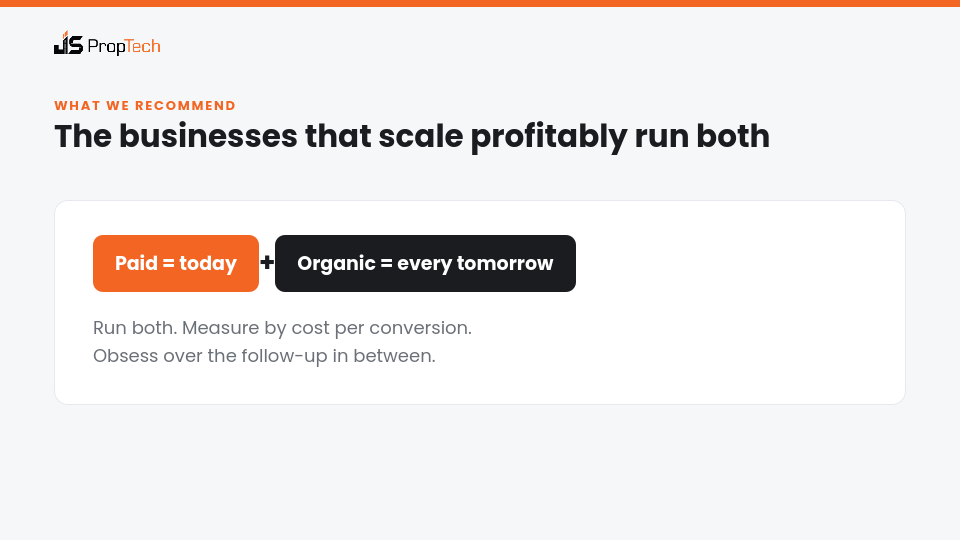
Treat paid and organic as partners, not rivals. Use paid to turn on demand when you need volume fast — launches, slow months, new micro-markets — and use that window to build the organic engine that lowers your blended cost per conversion month after month. The two are strongest together: paid gives you data and speed today, organic compounds that into a lower cost base tomorrow.
Paid buys you today; organic buys you every tomorrow. At JS PropTech we build exactly that blended system for real estate businesses — paid campaigns for immediate enquiries, an organic foundation for long-term compounding, and the speed-and-follow-up structure that turns both into closed deals. If you want to know your real cost per conversion, that is the place to start.