

AI Voice Calling Agents in Real Estate: Answer Every Lead in 30 Seconds
It is 9:47 on a Tuesday night when the enquiry lands. Somewhere across the city, a buyer named Meera has spent twenty minutes comparing 3 BHK projects on her phone, tapped a Meta ad, and filled in a lead form — name, number, budget, done. Her details drop into a dashboard nobody is watching. In the sales office the telecaller left at seven. The diary that holds the day’s leads — an actual diary, ruled pages, blue ink — is closed on a desk, waiting for morning.
At 10:15 the next day, someone finally dials. Meera does not pick up; she is at work. A second attempt at lunch goes the same way. By evening she has spoken to two other projects — one of them called her back ninety seconds after she enquired — and she has booked a Saturday site visit with the developer who answered first. The lead sitting in the diary did not go cold because it was a bad lead. It went cold because it waited twelve hours.
If you run a real estate agency, or you are a developer, builder or promoter spending serious money on Meta ads, Google ads and portal listings, you already know this story — it plays out nightly at every price point. What has changed is that the twelve-hour gap is now a solved problem, and the businesses solving it are not hiring more telecallers. They are letting an AI voice agent make the first call.
What slow response actually costs: the numbers
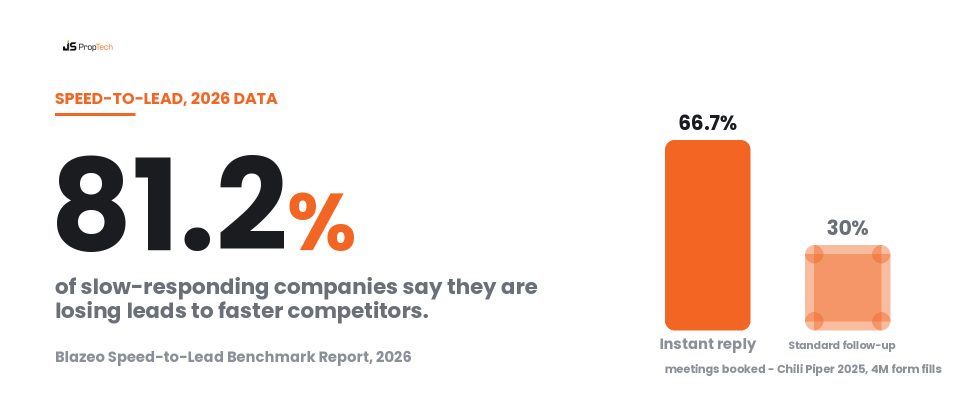
The freshest numbers make the case better than any decade-old study could. Chili Piper’s 2025 benchmark, built on four million real form submissions, found that an instant response booked a meeting 66.7% of the time against roughly 30% for standard follow-up — speed alone more than doubled conversion. A 2024 RevenueHero audit of 1,000 companies was harsher: 63.5% never responded to their web leads at all, and the rest averaged over 29 hours.
The 2026 numbers are blunter still. The Blazeo Speed-to-Lead Benchmark Report published this year found that 81.2% of companies taking more than an hour to respond admit they are losing leads to faster competitors. And real estate wears the problem worst: 2026 industry benchmarks put the average agent response at around fifteen hours — on enquiries that cost more to generate than almost any other vertical. Every one of those numbers describes paid-for enquiries quietly dying in someone’s inbox or diary.
Meet the AI voice calling agent
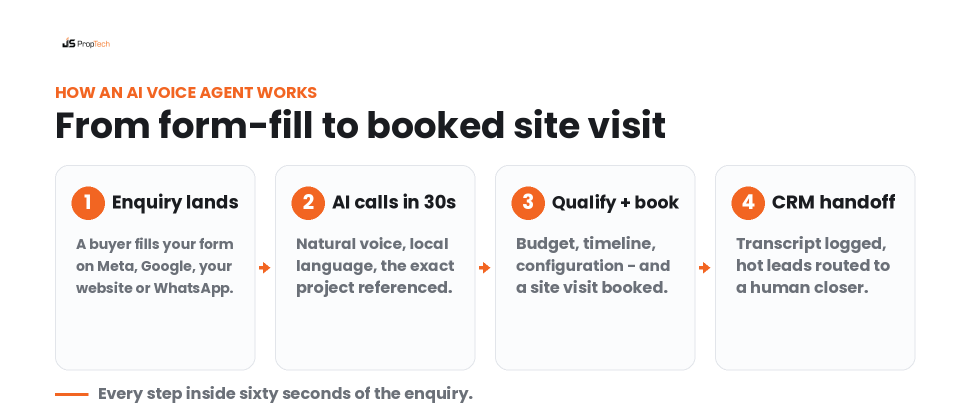
An AI voice agent is software that phones your lead the moment the enquiry arrives — from a Meta instant form, a Google lead form, your website, a landing page or a WhatsApp flow — usually within thirty to sixty seconds of the form being submitted. It speaks in a natural voice, greets the buyer by name, references the exact project they enquired about, and holds a short structured conversation: budget range, preferred configuration, possession timeline, and whether they would like a site visit.
Everything it hears is written down perfectly, every time. The qualified summary lands in your CRM with a recording and a transcript, the site-visit request is routed to a human closer, and the follow-up on WhatsApp fires automatically with the brochure and location pin. No diary, no handwriting, no “I’ll update the sheet tomorrow.” From Meera’s side of the phone, the experience is simple: she enquired, and thirty seconds later the project called her back — before her attention moved on and before your competitor did.
The diary-and-dialler routine, retired
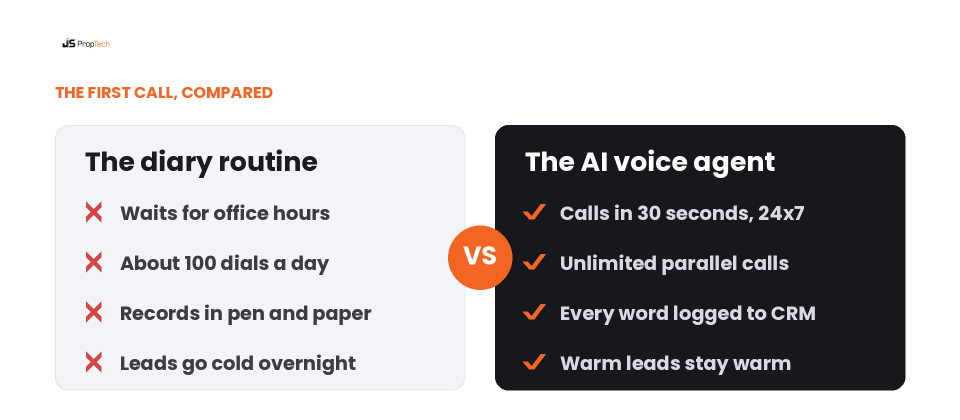
Contrast that with how most sales floors still run. A telecaller works down a list from the top, during office hours, at perhaps a hundred dials a day on a good day. Leads that arrive at night or on Sunday wait. Records live in pen — a diary, a register — so nobody can say which lead was called, what was discussed, or when the next follow-up is due. Two people call the same buyer; ten buyers get called by no one.
None of this is a people problem. It is a physics problem: humans sleep, take weekends, and can only hold one conversation at a time, while enquiries arrive in bursts at 10pm when your ads are cheapest. The fix is not asking your team to race a stopwatch at midnight. It is giving the first mile of the conversation to a machine that never sleeps, and reserving your people for the part of the job machines cannot do — the site visit, the negotiation, the close.
The economics: what changes when the first call is automated
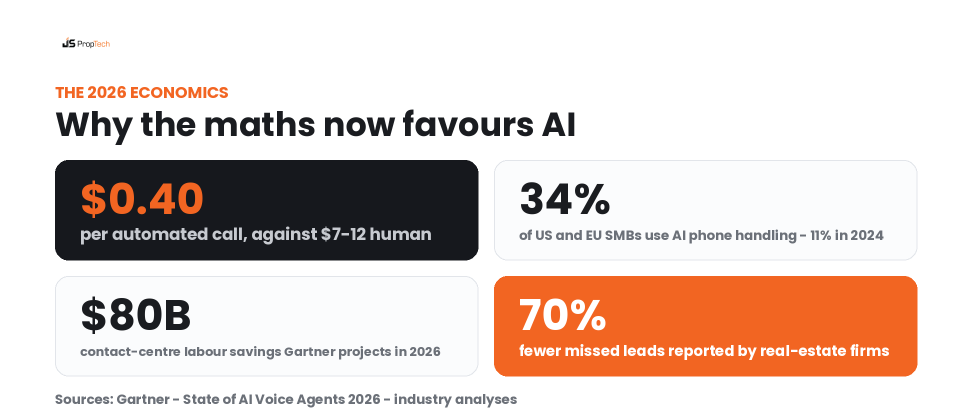
The cost curve is why this is moving fast. Gartner projects that conversational AI will cut contact-centre labour costs by around 80 billion dollars in 2026 alone, and current industry benchmarks put an automated voice call at roughly forty cents against seven to twelve dollars for a human-handled one. Adoption has followed the maths: the State of AI Voice Agents 2026 industry report estimates 34% of small and mid-size businesses across the US and Europe now use some form of AI phone handling, up from 11% in 2024. Real estate is a textbook case, because the first call is short, repetitive and script-shaped: exactly the work automation does best.
Run the local maths and it gets more persuasive. A telecaller in India typically costs ₹15,000–25,000 a month plus training and attrition, works fixed hours, and reaches a limited number of leads. An AI voice agent typically bills a few rupees per minute of talk time, makes unlimited simultaneous calls, answers in thirty seconds at 2am, speaks multiple languages, and never resigns during launch week. For a developer generating hundreds of enquiries a month, the same budget buys dramatically more contacted leads — and contacted leads are the only ones that ever become bookings. Industry analyses this year report real estate firms cutting missed lead opportunities by as much as 70% after deploying voice agents — the leads were always there; nobody was reaching them in time. That is the arithmetic behind a lower cost per conversion, without spending one extra rupee on ads.
What AI voice agents do not replace
A caution, because vendors oversell this: the AI does not close flats. Buyers still buy from people — the trust-building, the negotiation, the walk through the sample flat remain stubbornly human. The agent’s job is the first mile only: reach every enquiry in seconds, qualify it honestly, book the appointment, and hand a warm, documented lead to your closer instead of a cold name in a diary.
Doing it properly also means doing it transparently. Configure the agent to identify itself as a virtual assistant, respect calling-hour and DND norms, and hand off instantly when a buyer asks for a person. A badly scripted robot that pretends to be human damages your brand faster than a slow telecaller ever could; a well-built one simply feels like a project that is impressively quick to respond.
How to put one to work
The build is more plumbing than magic. Connect every lead source — Meta lead forms, Google lead forms, website forms, WhatsApp — to a webhook that triggers the call inside sixty seconds. Write a short qualification script in the languages your buyers actually speak. Define the handoff rule: anything qualified and site-visit-ready pings a human closer immediately, with the transcript attached. Then measure what you have always needed to measure — speed to lead, contact rate, site visits booked and cost per closed deal — and watch which numbers move first.
This is exactly the stack we build at JS PropTech for real estate agencies, developers, builders and promoters: the ad campaigns, the landing pages, and the AI-powered first-response layer wired into one system — so turnaround on a warm lead drops from hours to seconds, and the cost, time and manpower spent on manual first calls gets redeployed to closing.
The first sixty seconds decide the next sixty days
Strip away the buzzwords and the argument is simple. Your marketing already produces intent; the research says that intent evaporates in minutes; and the diary-and-dialler routine was never built for minutes. AI voice calling agents close that gap at a cost that makes the old way look expensive, while your best people spend their day where they earn the most — in front of buyers.
The future of real estate sales is not humans versus AI; it is humans who close, backed by machines that never let a lead go cold. At JS PropTech we help you build that advantage before your rivals do — because if a machine can greet every enquiry in thirty seconds while your competitor’s diary sleeps, how many more Saturdays will you let Meera book her site visit with someone else?