

Real Estate Marketing Automation: Connecting Ads, CRM and WhatsApp Into One System
Most real estate businesses run ads, a CRM, and WhatsApp as three separate tools that happen to sit near each other, not as one connected system. Real estate marketing automation is what happens when those pieces are actually wired together, so a lead moves from ad click to booked site visit without a single manual handoff in between.
Why disconnected tools quietly cost you deals
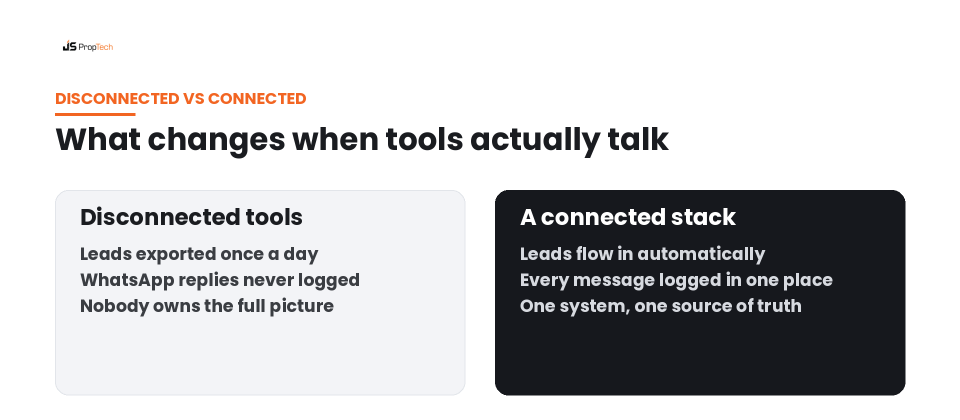
A Google Ads lead that lands in an inbox nobody watches, a Meta Ads lead exported into a spreadsheet once a day, a WhatsApp reply that never gets logged anywhere, each gap is small on its own. Stacked together across a month of leads, disconnected tools leak a meaningful share of the enquiries you already paid for.
The connected stack, piece by piece
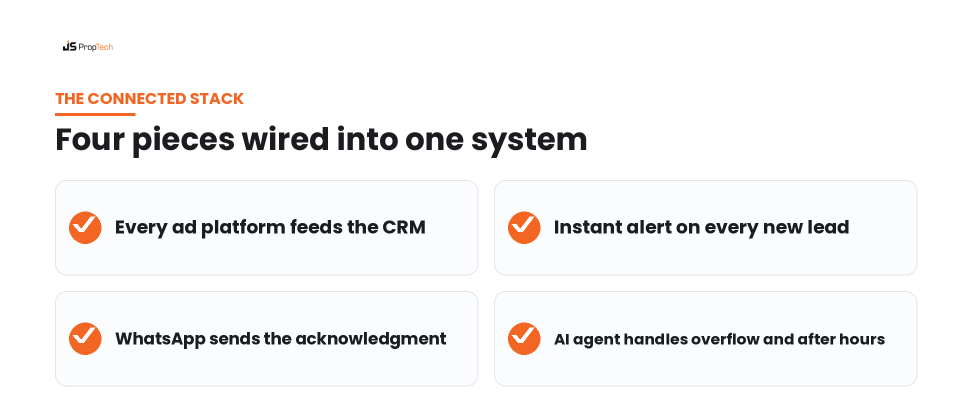
Every ad platform feeds directly into one CRM, no manual export, no daily download. The CRM triggers an instant alert the moment a lead arrives, routed to whoever owns first response. WhatsApp automation sends the acknowledgment and brochure within seconds. For leads arriving outside working hours or in high volume, an AI calling agent makes the first qualifying call before a human is even online.
What connection actually buys you
The value is not any single piece, it is that nothing depends on someone remembering to do something manually. Speed to lead stops being a discipline your team has to maintain and becomes a property of the system itself. A lead cannot go cold because nobody checked an inbox, because the system checked it automatically.
Where most businesses start, and where they should
Most real estate businesses start by buying a CRM and stop there, treating automation as a single purchase rather than a connected chain. Start instead by mapping every lead source you currently have, then wire each one into the CRM first, before adding WhatsApp automation or an AI calling agent on top. A connected two-piece system beats a disconnected five-piece one every time.
Measuring whether the stack is working
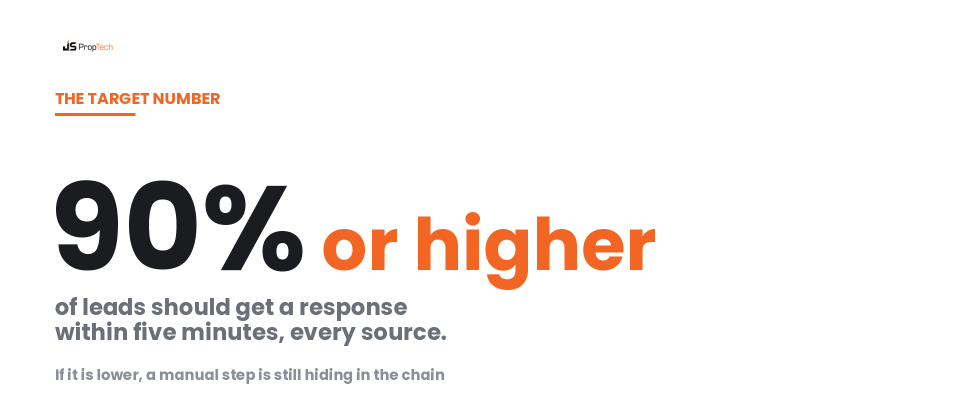
Track one number above all others: the percentage of leads that receive a first response within five minutes, regardless of source, time of day, or which platform generated them. If that number is not climbing toward 90 percent or higher within a month of connecting your stack, something in the chain still has a manual step hiding in it.
Real estate marketing automation is not about replacing your team. It is about making sure every lead they were always going to work gets to them fast, warm, and with nothing lost along the way. At JS PropTech we build this exact connected stack, ads, CRM, WhatsApp and AI calling working as one system, for real estate businesses ready to stop losing leads to gaps between tools.
Choosing tools that integrate well instead of fighting each other
The single biggest predictor of whether a marketing automation stack actually stays connected over time is not the quality of any individual tool, it is how well those tools were chosen to work together in the first place. A brilliant CRM that cannot cleanly receive data from your ad platforms, or a WhatsApp automation tool that cannot log conversations back into the CRM, forces manual bridging that quietly reintroduces the exact gaps automation was meant to close.
Before committing to any tool, check its native integration options against the rest of your stack, not just its individual feature list. A CRM with a proven, well-documented integration to Meta and Google lead forms is worth choosing over one with a longer feature list but only a clunky manual export process connecting it to your ad platforms. The features that look impressive in a sales demo matter far less than whether data actually flows automatically once the tool is live in your real workflow.
Where a clean native integration does not exist, a simple automation platform sitting between tools can often bridge the gap without needing custom development, though this adds a small amount of technical complexity worth weighing against the alternative of manual data entry. The goal throughout is minimising the number of places where a lead or a conversation has to be manually copied from one system to another, since every manual step is exactly where consistency breaks down under real-world pressure and volume.