

Real Estate Retargeting: How to Win Back Buyers Who Didn’t Enquire the First Time
Real estate retargeting starts from an uncomfortable truth: most of a property marketing budget goes into getting a buyer to your page for the very first time, and the overwhelming majority then leave without calling, without filling the form, without doing anything your sales team can act on. On a typical real estate campaign only a low single-digit percentage of first-time visitors convert on that first visit — which means the money spent bringing the other 90%+ in walks straight back out the door.
Retargeting stops you paying for that waste. Instead of chasing brand-new strangers every time, you show follow-up ads only to the warm audience that already visited your project page, watched your walkthrough, or opened your enquiry form and hesitated. Because these people already recognise your project, the cost to reach them again is a fraction of first-touch prospecting — and the conversion rate is far higher.
What real estate retargeting actually is
Retargeting (also called remarketing) works through a small tracking snippet — the Meta Pixel or the Google Ads tag — placed on your website and landing pages. When someone visits, they quietly join an audience list. You can then run ads shown only to that list, rather than to cold strangers who have never heard of you. It is the difference between knocking on a random door and following up with someone who already walked through your show flat.
The real power is in how finely you can slice these audiences: everyone who viewed the 3BHK page, everyone who watched more than half of your site-visit video, everyone who reached the enquiry form but never submitted it. The tighter and more recent the audience, the more relevant your message can be — and relevance is exactly what makes retargeting so cheap compared with fresh prospecting on Google Ads or Meta.
Why property buyers rarely convert on the first visit
A home is the largest purchase most families ever make, so nobody enquires on impulse. There are site visits to plan, family members to consult, loan eligibility to check and three or four competing projects to compare. That consideration window routinely stretches across weeks or months, and a buyer usually needs several exposures to a project before they are ready to raise their hand.
This is also why the other half of the equation matters so much: the instant a buyer does enquire, speed to lead decides whether you win them. Retargeting keeps you visible through the long, silent research phase so that when the buyer is finally ready, yours is the project that already feels familiar — and your fast follow-up closes the loop.
Setting up retargeting on Meta
Start by installing the Meta Pixel across your whole site and every landing page. Once it is collecting data, build Custom Audiences from the actions that signal intent: page visitors over the last 30, 60 and 90 days, video viewers, and — the most valuable of all — people who opened your lead form but did not complete it. Later, once you have a pool of real converters, you can layer a Lookalike audience to expand reach.
Two rules keep Meta retargeting efficient. First, always exclude people who have already enquired, so you are not burning budget re-showing ads to leads your team is already calling. Second, send the traffic to a focused landing page built around that specific project, never to a generic homepage where a warm buyer has to hunt for the offer again.

Setting up retargeting on Google
Google gives you more surfaces to work with. Install the Google Ads tag, then run Display and YouTube remarketing to your visitor lists, Discovery ads across Gmail and the feed, and RLSA (Remarketing Lists for Search Ads) so past visitors see stronger bids and sharper copy the next time they search for your area or project.
YouTube remarketing in particular is underused by builders. A 15-second walkthrough shown only to people who already visited your project page costs very little and keeps the property top of mind through the whole decision window. Run it alongside your existing search campaigns rather than as a replacement for them.
What to show a buyer the second, third and fourth time
The most common retargeting mistake is showing the exact same ad on repeat until the buyer tunes it out. Sequence the message instead. The first touch after a visit should reinforce the core promise — location, price band and possession timeline. The next should build proof: construction progress, RERA registration, a genuine testimonial or a site-visit invite. Only then do you introduce a reason to act now, such as limited inventory, a launch price or a festive offer.
Match the creative to how warm the audience is. Someone who abandoned your form needs a direct nudge — a callback offer or a WhatsApp link — not another brand-awareness clip. Someone who merely skimmed the page needs the single strongest benefit repeated clearly. One message per audience, in a deliberate order, beats one loud ad shown to everyone.
Budgets, frequency and measuring what works
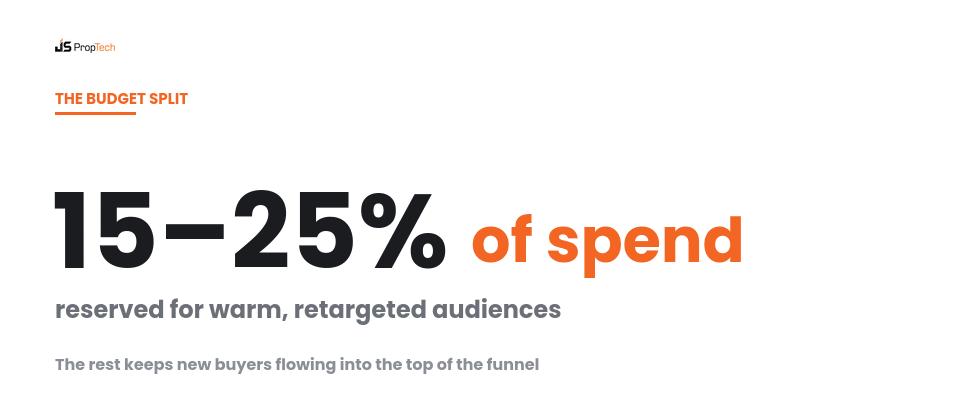
Retargeting should be a slice of the budget, not the whole plan — you still need cold campaigns feeding new visitors into the top of the funnel. A practical split is to reserve roughly 15–25% of spend for warm audiences. Set frequency caps of a few impressions per week so your ads stay present without tipping into annoyance, and refresh the creative before it goes stale.
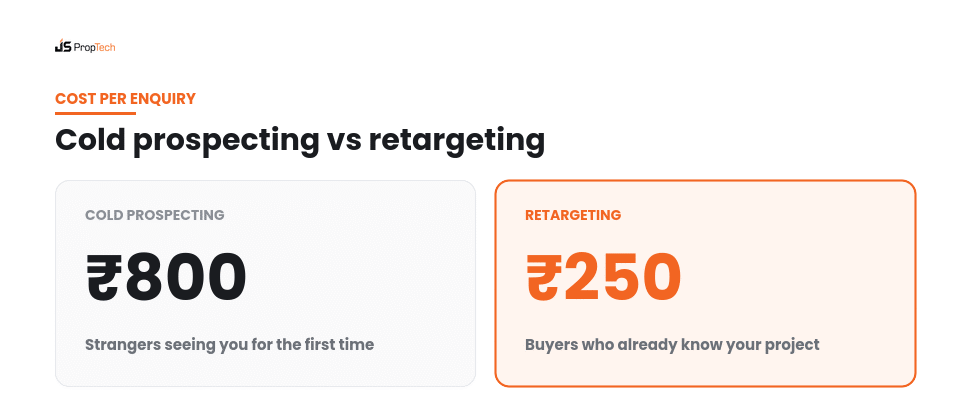
Judge the results by cost per qualified lead, not by clicks or impressions. If cold prospecting brings enquiries at ₹800 each and retargeting brings comparable enquiries at ₹250, every rupee you shift toward warm audiences stretches the same budget much further — the full logic of which is worth reading in our breakdown of cost per conversion. Track view-through conversions as well, because property buyers often see a retargeting ad, then return a day later through a direct search.
Set up well, real estate retargeting turns the traffic you have already paid for into a compounding asset instead of a one-time expense, and it usually produces the cheapest qualified leads in the entire account. At JS PropTech we build these warm-audience loops on top of a builder’s existing ad and CRM setup so that no enquiry — and no ad rupee — is quietly wasted. If nine out of ten buyers currently leave your site without a trace, how much of that audience are you actually bringing back?